Cracking JEE without coaching: the five problems you now have to solve yourself
The question keeps coming up — on Reddit, in WhatsApp groups, at kitchen tables the night before a fee is due:
Can you actually crack JEE without expensive coaching?
The honest answer is yes. Thousands do it every year. But almost none of them do it by watching more lectures.
Here is the part the fee never told you. The ₹1–2 lakh a year was not really payment for content. Concept videos, question banks, formula sheets, decades of past papers — all of that is abundant now, and most of it is free.
What the money actually bought was a system: someone deciding what you study today, someone telling you why your answer was wrong, someone making sure you did not forget September’s chapters by April, and someone watching whether your effort was working at all.
Take away the building and the brand, and that system is the thing you have to reproduce. It breaks into five jobs. Do them, and the coaching center was never the point.
1. What do I study today?
A self-studier opens the books and the hardest question is not a physics question. It is what is the single most useful thing to do right now?
The lowest test score? The chapter you just failed? The next topic in some YouTube playlist? Usually none of these. The real blocker is often a prerequisite — you are grinding a hard topic while a simpler dependency underneath it is still shaky.
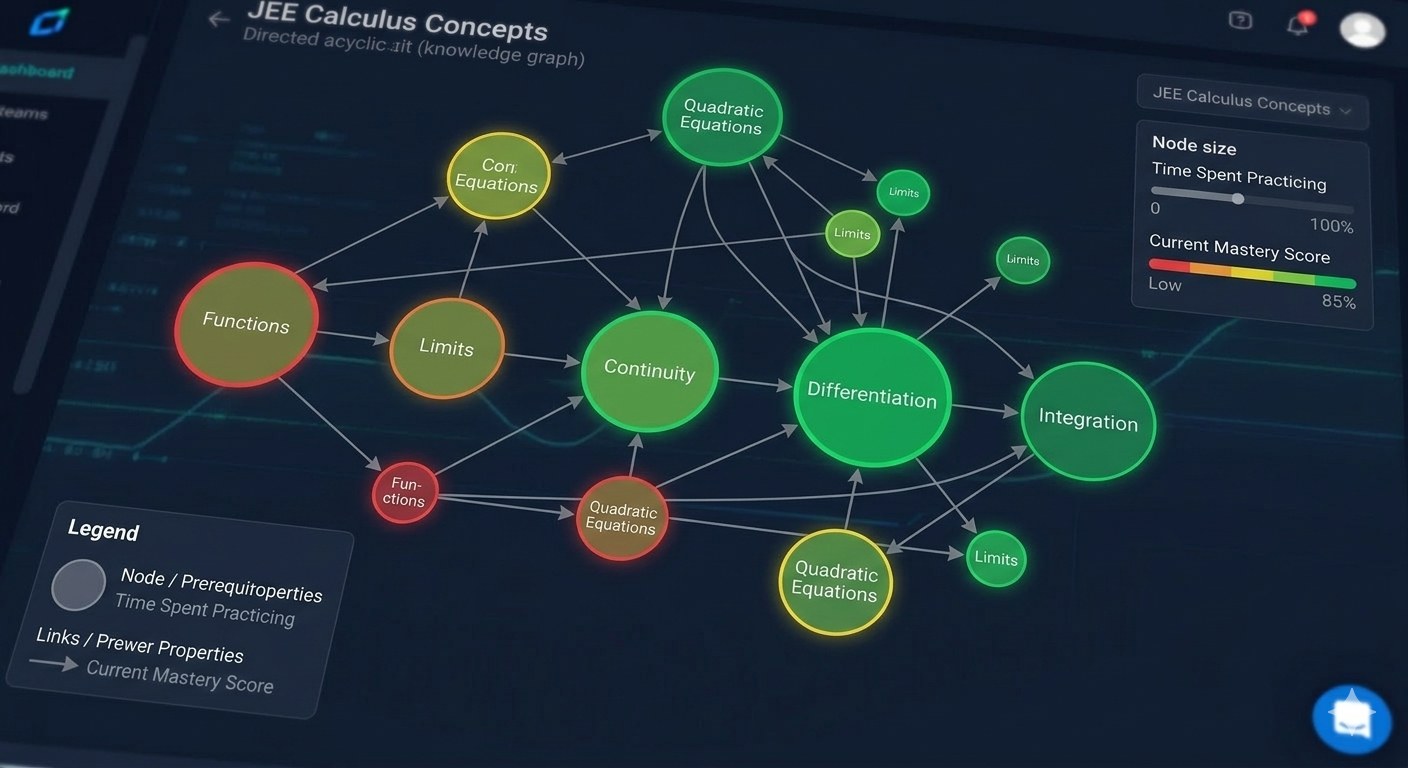
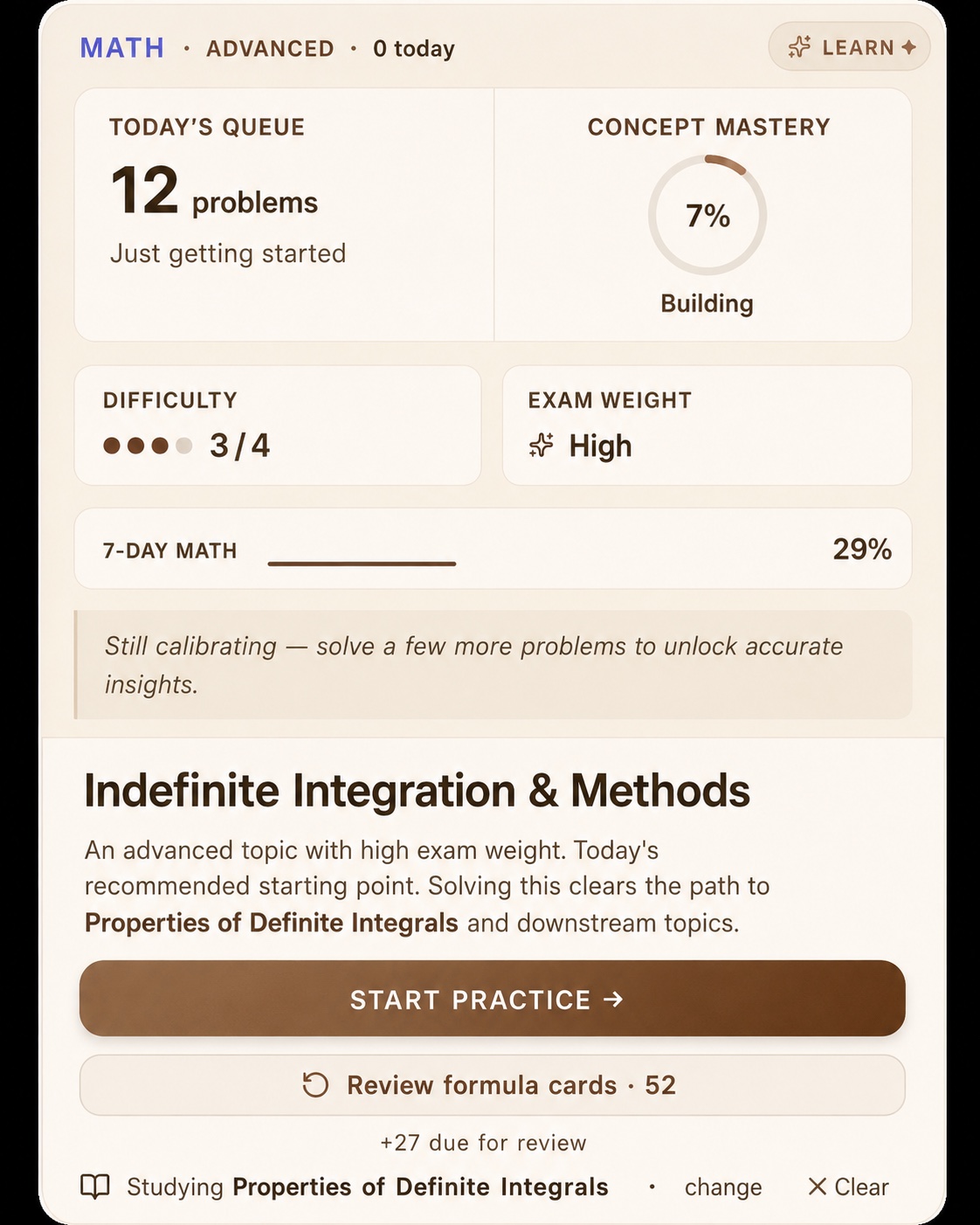
Rhovecs answers this with a concept dependency graph. Your Today’s Focus is not random — it is one step in a path made of prerequisites, the current concept, the patterns that concept tests, and the evidence you have produced so far.
Electromagnetism will not surface while Vector Calculus is still unstable; the graph blocks it. When Vector Calculus firms up, Electromagnetism unlocks automatically. No study plan to draw up, no revision calendar to maintain — the next step is already chosen, and you can see why.
Here is what that looks like on a given morning:
2. Was I actually wrong — and why? (And am I even practicing everything?)
In a coaching batch, a teacher glances at your sheet and says “you are weak in this kind of problem.” Self-study removes that second pair of eyes, and two blind spots open up.
The first is coverage. JEE does not ask random questions — NTA reuses a finite set of problem patterns. You can practice for months and still never touch entire pattern classes, and never know it.
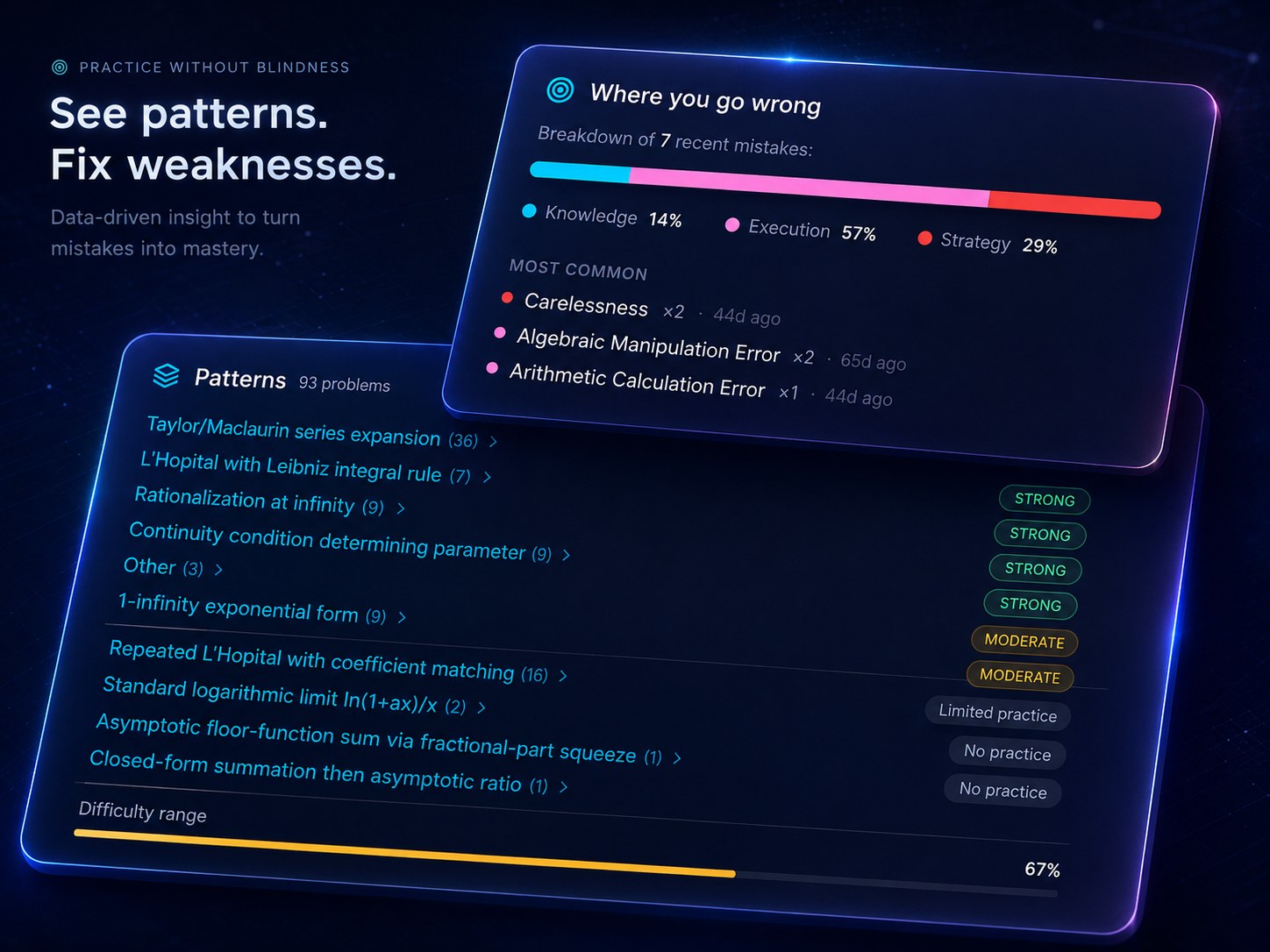
Rhovecs tracks every pattern that has historically been asked for a concept and shows where you stand — how much of a concept’s pattern space you have covered and where the gaps remain. Coverage stops being a guess. If there is a pattern class you have never attempted, it shows up, not hidden in a blind spot.
The second blind spot is the wrong answer itself. On your own, a wrong answer is just wrong. Rhovecs treats it as evidence: it classifies the mistake — was the gap knowledge, execution, or strategy? — and tells you the repair it calls for: relearn, revise, or simply drill the pattern again.
So “you missed this chapter” becomes “you dropped Conservation of Angular Momentum on off-centre collisions — here are drills for exactly that.”
3. How do I not forget March’s chapters by May?
This is the quiet killer of self-study. You master a chapter in January and move on. Three months without active recall is enough for retention to fall sharply, and by mid-April the chapter that felt solid feels foreign — right when you need it most.
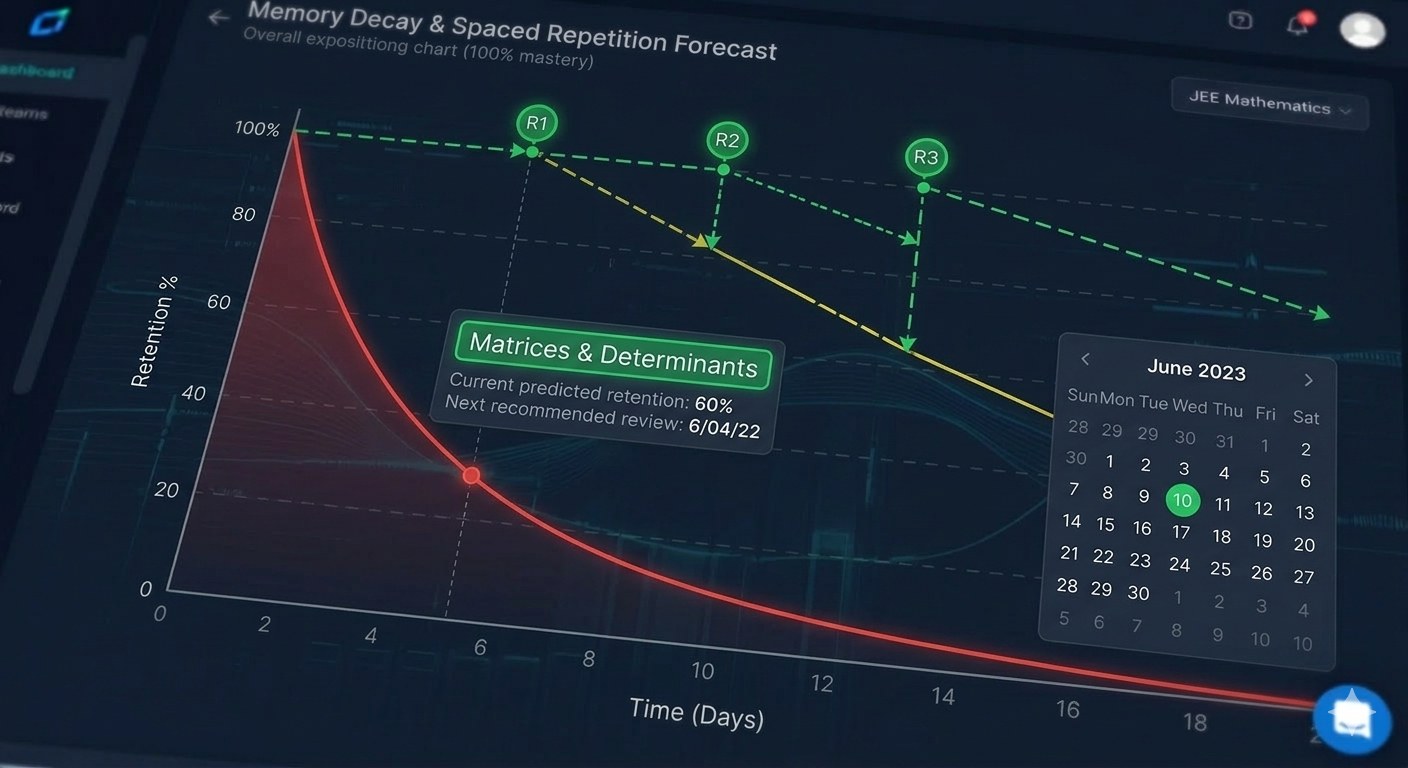
Coaching papers over this with periodic revision tests on a fixed calendar. On your own, nothing forces the review — and silently forgetting old topics while chasing new ones is the default outcome.
Rhovecs tracks forgetting risk per concept and surfaces a prioritised review queue before retention decays too far. You do not maintain a spaced-repetition spreadsheet; the system ranks what is due and works through it with you.
4. Do my mock scores mean anything?
A mock score is a number. The useful question is what the number is made of.
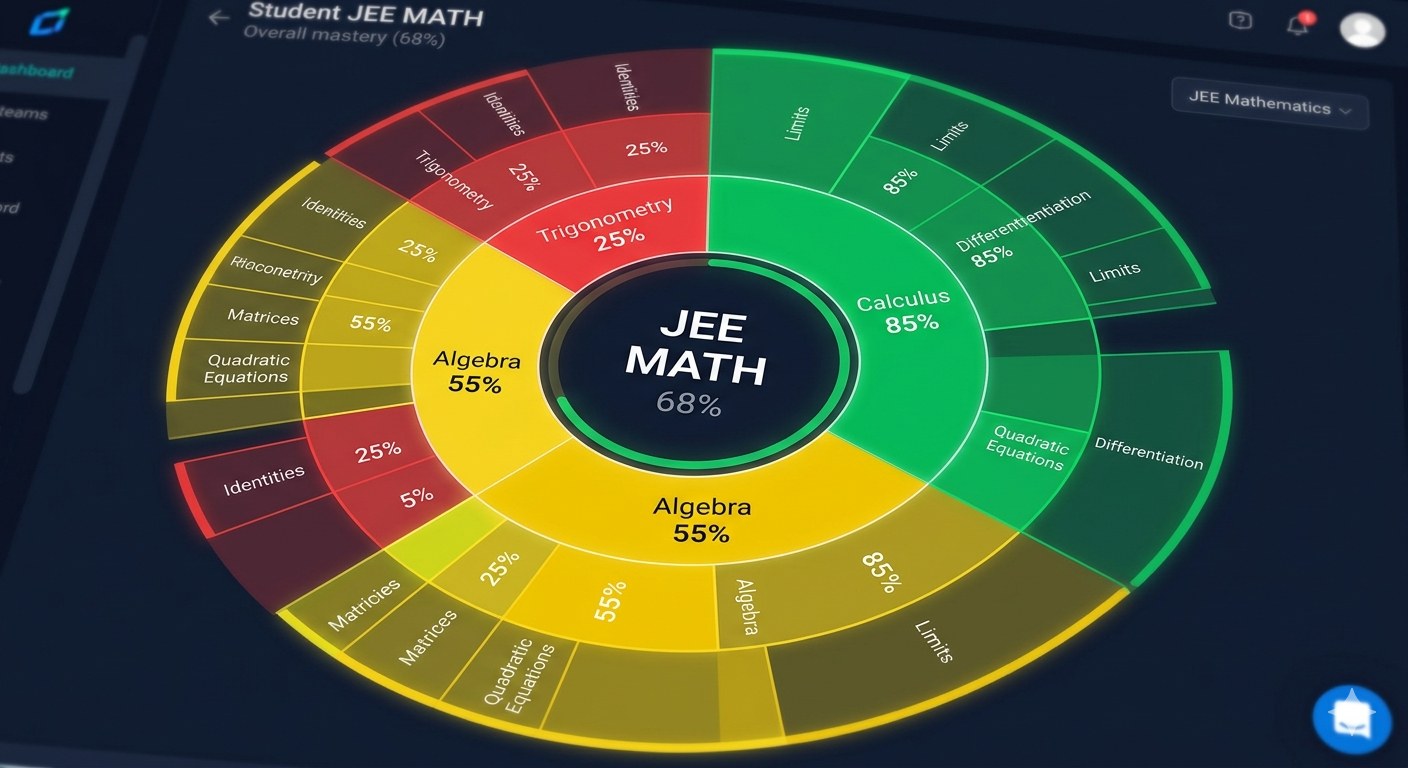
Rhovecs builds mocks from your own evidence — weak patterns, forgotten concepts, readiness gaps — not a generic syllabus calendar. A test stops being a verdict and becomes part of the loop.
And the mastery behind it is coverage-based, not just correctness. The score reflects how much of a concept’s pattern space you have actually practiced and how well you did — not merely whether your last few attempts happened to be right. That distinction matters: a streak of lucky guesses on familiar questions will not inflate it, and broad, demonstrated mastery will. You can trust the number because you can see what is underneath it.
5. Who’s keeping me honest?
Coaching’s most underrated feature is social. A fixed schedule, a batch sitting around you, and a teacher — and your parents — who notice when you drift.
Strip that away and discipline becomes the whole game. Rhovecs cannot sit beside you, but it replaces part of the structure: practice trends show whether your accuracy and mastery are actually moving session over session, not just whether you “studied.”
And once a week, the student — and their parent — get the same plain-language WhatsApp report: problems practiced and time spent in each subject with a trend label, the concepts that crossed the mastery threshold that week, and the highest-leverage areas to work on next. For the student it is a Sunday-morning checkpoint; for a parent weighing a large cheque, it is the real trade. Part of what the coaching center sold was visibility — proof the money was working. A weekly report gives you that visibility without the cheque.
Where AI fits
The modern self-studier has one more instinct: “I’ll just ask ChatGPT.” Fair — and genuinely useful. But a generic chat box only knows what you type into it. It does not know your recent attempts, your recurring mistakes, your weak prerequisites, or whether you should even be on this problem today.
Rhovecs flips the order. The deterministic engine owns the context — current concept, prerequisite gaps, recent errors — and builds the prompt. You bring the model: ChatGPT, Gemini, Claude, whichever you prefer. So instead of “explain this problem,” the AI receives “this student keeps missing the factorisation step before substitution — give a hint that points there without solving it.” Same AI, far better help.
What this won’t replace
Be clear about the limits. Rhovecs does not take the exam for you. You still put in the hours, and you still have to think hard about problems — that part is non-transferable. A genuinely great teacher is still a genuinely great teacher, and if you have access to one, keep them.
What Rhovecs replaces is the coordination layer — the decide-what-next, catch-the-mistake, beat-the-forgetting, prove-it-is-working machinery that the coaching fee quietly bundled in. That layer used to cost a seat in a hall of two hundred students. It does not anymore.
So — can you crack JEE without expensive coaching? Yes. You just have to do the five jobs the fee used to do for you. That is exactly what Rhovecs is built for.
Rhovecs’s 14-day full trial puts the engine in your hands. No card required. Start at jee.rhovecs.com.